When schools and athletic facilities choose football goal posts, they have more than one design to consider. While gooseneck goal posts are common on many modern football fields, H-style goal posts offer another option. H-style goal posts are often used on practice fields, recreational fields, and at parks where a traditional goal post design, limited space, or a tighter equipment budget may influence the decision.
So what makes H-style goal posts different? Why might a school or parks department choose them over a gooseneck design? And what should you consider before selecting one for your facility? Understanding the differences can help you choose the right football goal post for your field.
What Is an H-Style Football Goal Post?
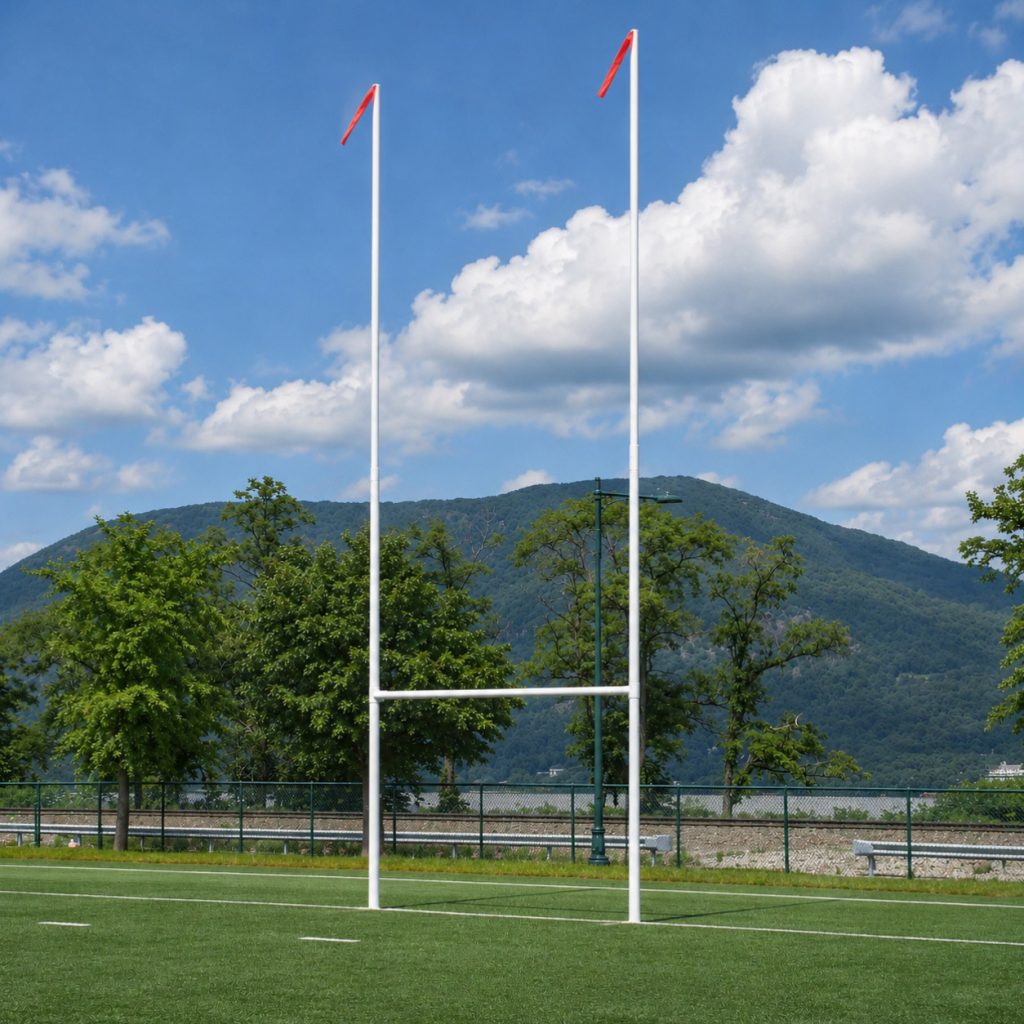
An H-style football goal post gets its name from its recognizable shape. It uses two vertical support posts connected by a horizontal crossbar, with two uprights extending above the crossbar to create the scoring target. Unlike a gooseneck goal post, which uses a single support structure with a curved extension, the H-style design has two ground-supported posts. This creates a more traditional, symmetrical appearance that has been used on football fields for generations.
H-style goal posts are available for both high school and college applications. They can be a practical choice for facilities that need a functional football goal post without the larger stadium-style appearance of some other designs.
H-Style vs. Gooseneck Football Goal Posts: What’s the Difference?
The main difference between H-style and gooseneck football goal posts is their support structure.
H-style goal posts use two vertical supports connected by a crossbar. The design creates a centered, balanced appearance and can require less offset space behind the end line than a gooseneck system.
Gooseneck goal posts use a single support structure with a curved extension that supports the crossbar and uprights. This design is common on high school, college, and professional competition fields.
Here are some of the key differences:
| Feature | H-Style Goal Posts | Gooseneck Goal Posts |
|---|---|---|
| Support design | Two vertical supports | Single support with curved extension |
| Appearance | Traditional, symmetrical design | Curved, offset design |
| Space considerations | Often requires less offset space behind the end line | Requires room for the rear support and curved extension |
| Common applications | Practice fields, parks, recreational facilities | Competition fields and stadiums |
| Cost considerations | Economical alternative | Can involve a higher equipment investment, depending on configuration |
Neither design is automatically better. The right choice depends on the field, available space, intended use, and project budget.
Why Choose H-Style Football Goal Posts?
H-style goal posts aren’t just an alternative design. They offer practical advantages for certain athletic facilities. Here are four reasons schools, parks departments, and athletic organizations consider them.
1. They Work Well for Practice Fields
Practice fields don’t always need the same equipment configuration as a primary competition stadium. A school may have one main football field for games and a separate field for daily practices, kicking drills, and team activities. The practice field still needs dependable goal posts, but the facility may have different priorities when selecting equipment.
H-style football goal posts offer a practical option for these settings. Their straightforward support design and economical price point make them worth considering when outfitting additional football fields.
2. They’re a Practical Option for Parks and Recreational Facilities
Community parks and recreational facilities often need equipment that supports local sports programs while staying within an established budget. H-style goal posts can be a good fit for these locations, including fields used by youth football programs and community athletic organizations. They provide the familiar football scoring target without requiring a facility to invest in a more elaborate goal post configuration.
For parks departments managing several athletic fields, selecting equipment that balances function, durability, and cost is an important part of planning.
3. They Can Help When Space Is Limited
Available space is an important consideration when planning football field equipment. Some facilities have limited room behind the end zone because of property boundaries, walkways, fencing, existing structures, or other site conditions. H-style goal posts can help address these challenges because their configuration often requires less offset space behind the end line than gooseneck designs.
That doesn’t mean they can be installed anywhere. You still need to account for the two support posts, ground sleeves, installation requirements, and appropriate clearances. Reviewing the field layout before selecting a goal post can help determine which design makes the most sense.
4. They’re an Economical Alternative to Gooseneck Goal Posts
Equipment budgets can influence decisions, especially when a school or parks department needs to outfit multiple fields. H-style goal posts offer a more economical alternative to gooseneck-style goal posts, making them worth considering when balancing equipment needs with available funding.
The final project cost will depend on the selected model, installation requirements, site conditions, and any additional accessories. When comparing options, consider the full project cost rather than looking at the equipment price alone.
What H-Style Football Goal Posts Does Sportsfield Specialties Offer?
Sportsfield Specialties offers four H-style football goal post models for high school and college applications. Each model features durable aluminum construction and a fade-resistant powder-coated finish available in yellow or white. Ground sleeves and directional wind flags are included, and an optional access frame kit is available separately. The models are available with either 20-foot or 30-foot uprights.
High School H-Style Football Goal Posts
GPH20HS – 20-Foot Uprights
- 20-foot upright height
- 23-foot, 4-inch crossbar width
- Designed for high school applications
GPH30HS – 30-Foot Uprights
- 30-foot upright height
- 23-foot, 4-inch crossbar width
- Designed for high school applications
College H-Style Football Goal Posts
GPH20COL – 20-Foot Uprights
- 20-foot upright height
- 18-foot, 6-inch crossbar width
- Designed for college applications
GPH30COL – 30-Foot Uprights
- 30-foot upright height
- 18-foot, 6-inch crossbar width
- Designed for college applications
Choosing the correct model comes down to the intended level of play and the specifications required for your field.
What Should You Consider Before Choosing H-Style Goal Posts?
Before purchasing football goal posts, take time to evaluate your facility’s needs.
Here are five things to consider:
1. Intended use
Will the goal posts be used on a primary competition field, a practice field, or a recreational field? Make sure the selected model is appropriate for the intended use.
2. Level of play
High school and college football have different goal post specifications. Confirm the required upright height, crossbar width, and other applicable dimensions before ordering.
3. Available space
Measure the area behind the end zone and identify any site limitations. Consider the location of fences, walkways, buildings, and other structures.
4. Installation requirements
Review the ground sleeve locations, foundation requirements, soil conditions, and installation instructions. Have underground utilities identified before excavation and confirm that the installation meets the manufacturer’s requirements.
5. Budget and long-term needs
Consider the equipment cost, installation, accessories, and expected maintenance. Choose a goal post system that meets your current needs without overlooking future facility plans.
Taking these steps can help you avoid choosing a system that doesn’t fit your field or intended use.
Are H-Style Goal Posts Right for Your Football Field?
H-style goal posts are not intended to replace gooseneck goal posts in every application. Both designs have a place in athletic facilities.
If you’re outfitting a major competition stadium and want a familiar modern stadium appearance, a gooseneck design may be the right choice. If you’re equipping a practice field, community park, or recreational facility, an H-style goal post may offer the practical combination of function, space considerations, and value you’re looking for.
The important thing is to match the goal post to the facility, the level of play, and the available installation space.
Explore H-Style Football Goal Posts From Sportsfield Specialties
Choosing the right football goal post is an important part of planning an athletic facility.
Sportsfield Specialties offers H-style football goal posts in high school and college configurations, with 20-foot and 30-foot upright options. Durable aluminum construction, powder-coated finishes, and included ground sleeves and directional flags make them a practical choice for facilities looking for an economical alternative to gooseneck-style goal posts.
Whether you’re outfitting a school practice field, upgrading a community athletic complex, or planning equipment for a recreational facility, Sportsfield Specialties can help you find the right option.
Looking for an H-style football goal post? Explore Sportsfield Specialties’ H-Style Football Goal Posts or contact our team to discuss your project.