Padel court padding is easy to overlook when planning a new court. Most of the attention goes to the glass, turf, steel structure, lighting and foundation. But the areas around the court entrances and net posts deserve attention too.
Players move quickly around a padel court. During a rally, they may chase a ball toward an entrance, change direction near the net or leave the court during authorized out-of-court play. These movements can bring players close to fixed structural components.
Padel court padding adds a layer of cushioning around specific contact areas. It also plays an important role in court design when out-of-court play is permitted.
Under the 2026 International Padel Federation (FIP) Rules of Padel, courts designed for out-of-court play must have cushioning on the three sides of each access point and on the net posts. The specified minimum padding thickness is 2 cm, and the protection must be firmly attached to the structure.
Padding is only one part of those requirements. The court also needs the correct access configuration and a clear safety area outside the playing enclosure.
If you’re planning a new padel court or upgrading an existing facility, here’s what you should know about padding requirements, placement, materials, compatibility and product selection before you buy.
What Is Padel Court Padding?
Padel court padding is protective cushioning installed over selected structural components of a padel court.
The main areas include:
- Court entrance and exit areas.
- Net posts.
The padding creates a cushioned surface over these hard components. It isn’t installed on the playing surface and shouldn’t interfere with normal court dimensions or gameplay.
The design and installation matter. Padding needs to fit the court structure, provide the required coverage and remain securely attached during normal use.
Padel Court Entrance/Exit and Net Post Padding
Sportsfield Specialties offers PaDelhi™ Padel Court Entrance/Exit and Net Post Padding for compatible PaDelhi™ court systems.
The product includes:
- 1 1/4-inch-thick high-impact polyurethane foam.
- 19-ounce premium outdoor vinyl with high UV resistance.
- A top-cap access flap with hook-and-loop attachment.
- A variety of standard vinyl color options.
- Optional custom digitally printed lettering and graphics.
The standard padding is available in sets of two. A separate product option is available with custom digitally printed graphics.
These specifications are identified in the current PaDelhi™ product cut sheet. Always confirm the product configuration and compatibility with the selected court system before ordering.
Where Is Padel Court Padding Installed?
Padel court padding isn’t designed to cover the entire court. It is installed around specific structural areas where players may come into contact with the court.
The FIP rules identify two main locations for cushioning on courts designed for out-of-court play: the access points and net posts.
Entrance and Exit Areas
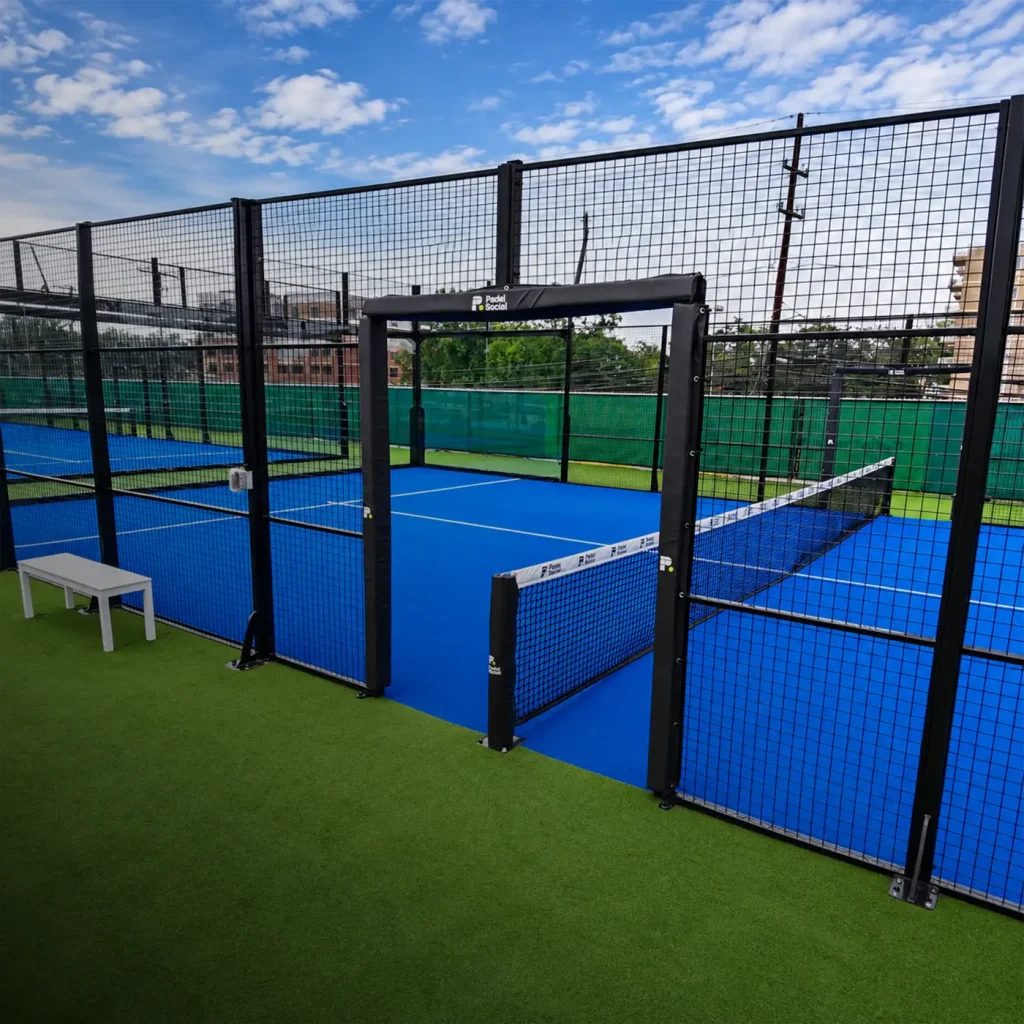
Padel court entrances are built into the sides of the enclosure. When out-of-court play is authorized, players may move through these openings to return a ball.
The FIP rules require cushioning on the three sides of each access point:
- The left lateral side.
- The right lateral side.
- The upper side.
The protection must be firmly attached to the metal structure and positioned to minimize interference with play.
When planning a new court, make sure the padding is coordinated with the access configuration and surrounding safety area.
Net Posts
Net posts are another area covered by the FIP cushioning requirements for out-of-court play.
The FIP rules state that net posts may be circular or square, but their edges must be rounded. The rules also require the posts to have cushioning when the court is designed for out-of-court play.
Padding provides a cushioned covering around the post. Its dimensions, fit and attachment should be appropriate for the specific court system.
Is Padel Court Padding Required?
Under the 2026 FIP Rules of Padel, cushioning is required on the three sides of each access point and on the net posts for courts designed for out-of-court play. The rules specify a minimum padding thickness of 2 cm and require the protection to be firmly attached to the structure.
The requirements are part of a larger set of specifications for out-of-court play. These include:
- Two access points on each side of the court.
- An obstacle-free safety area outside the court.
- A minimum safety-area width of 3 meters, with 4 meters recommended.
- A safety-area length of 4 meters on either side.
- A minimum clear height of 3 meters.
- Properly cushioned access points and net posts.
The safety area must remain free of obstacles within the dimensions specified by the rules. These requirements matter when planning a facility for competition or other play that permits players to leave the court.
The applicable requirements for your project may also depend on the competition organizer, governing body, local regulations and intended facility use. Confirm the requirements with the appropriate project professionals before construction.
What Is Out-of-Court Play?
Out-of-court play allows players to leave the court to return a ball under the conditions established by the rules.
During a rally, a player may chase a ball that travels outside the enclosure and attempt to return it before the point ends. This type of play requires more than an open entrance. The court must have the required access points and a clear safety area outside the enclosure.
That outside space is an important part of the court design.
When planning for out-of-court play, consider:
- Court placement.
- Access openings.
- Building layout.
- Walkways.
- Nearby courts.
- Seating.
- Equipment.
- Walls and other obstacles.
- Safety-area dimensions.
- Padding placement.
For a new facility, these decisions should be made before the court layout is finalized. Adding padding after installation won’t correct an inadequate safety area or an unsuitable access configuration.
What Should You Look for When Buying Padel Court Padding?
Not all padding is appropriate for every padel court. When comparing products, look beyond appearance and consider how the padding fits the court design.
1. Court Compatibility
Start with the court itself.
Padding should be designed for the specific court structure or confirmed by the manufacturer as compatible. This is especially important when adding padding to an existing court.
Before ordering, confirm:
- Court manufacturer.
- Court model.
- Structural dimensions.
- Access configuration.
- Net post dimensions.
- Padding attachment method.
Don’t assume padding designed for one court system will fit another.
2. Required Coverage
Make sure the padding covers the areas required for the intended court configuration.
For courts designed for out-of-court play under FIP rules, this includes the three sides of each access point and the net posts.
The padding must fit the structure without creating unnecessary projections into the playing area.
3. Padding Thickness
Thickness is an important specification.
The 2026 FIP Rules of Padel specify a minimum thickness of 2 cm for cushioning on the access points and net posts of courts designed for out-of-court play.
Sportsfield Specialties’ PaDelhi™ padding uses 1 1/4-inch-thick high-impact polyurethane foam, which is approximately 3.2 cm thick.
However, thickness alone doesn’t establish that an entire installation meets the applicable requirements. Coverage, attachment and court configuration also matter.
4. Attachment
Padding needs to stay securely in place.
The FIP rules require cushioning to be firmly attached to the metal structure and posts. The fastening method must maintain the protective function while minimizing interference with play.
Ask the manufacturer how the padding attaches to the court and whether the attachment is designed for the selected court configuration.
5. Material and Exterior Covering
The padding material and exterior covering affect how the product performs in its intended environment.
Consider:
- Indoor or outdoor installation.
- Frequency of play.
- Cleaning requirements.
- Weather exposure.
- Sun and UV exposure.
- Expected wear.
- Replacement options.
The PaDelhi™ padding cut sheet identifies high-impact polyurethane foam with a 19-ounce premium outdoor vinyl exterior. The vinyl is specified with high UV resistance.
These details are useful when evaluating padding for an indoor or outdoor facility.
6. Appearance and Customization
Appearance may not be the first consideration, but it can matter in a commercial facility. Padding can complement the overall court design and facility branding. Depending on the product, available options may include:
- Standard vinyl colors.
- Club or school colors.
- Facility names.
- Sponsor graphics.
- Tournament branding.
Sportsfield Specialties offers standard vinyl colors and an option for custom digitally printed lettering and graphics on its PaDelhi™ padding.
If you’re considering custom graphics, confirm artwork requirements and production details before ordering.
Does Padel Court Padding Affect Gameplay?
Properly selected and installed padding should provide the required cushioning without creating unnecessary interference with play.
The FIP rules specifically state that the protection should be firmly attached and designed to minimize interference caused by its projection into the court.
That makes the fit, attachment, thickness and placement important.
Padding shouldn’t obstruct the entrance, create unnecessary projections into the playing area or interfere with normal player movement.
When selecting padding, confirm that the product is designed for the court system and intended use.
Should You Add Padding to a New Padel Court?
If your new court will be designed for out-of-court play, padding needs to be included as part of the court design to address the applicable FIP requirements.
Even if you’re not planning to allow out-of-court play, it’s worth discussing padding with the court manufacturer during the planning process.
Including padding early gives you an opportunity to:
- Confirm court compatibility.
- Review applicable rules.
- Choose the correct coverage.
- Coordinate installation.
- Include the cost in the project budget.
- Select colors or graphics.
- Avoid unnecessary retrofit work later.
We’ll coordinate the requirements with the architect, engineer and contractor before construction begins. It’s easier to address padding and access-area requirements during design than after the court is installed.
Can You Add Padding to an Existing Padel Court?
In some cases, yes. The first step is confirming whether compatible padding is available for the existing court.
Before ordering retrofit padding, verify:
- Court manufacturer and model.
- Structural dimensions.
- Net post dimensions.
- Access configuration.
- Required coverage.
- Attachment method.
- Applicable playing rules.
The manufacturer can help determine whether the padding is compatible and whether the installation is practical.
If the padel court is used for competition or out-of-court play, also confirm that the completed installation meets the applicable requirements. Adding padding alone doesn’t establish compliance with the full court and safety-area specifications.
How Much Does Padel Court Padding Cost?
There isn’t one price that applies to every padel court padding project.
The total cost can depend on:
- Number of courts.
- Number of padded locations.
- Padding specifications.
- Court compatibility.
- Standard or custom graphics.
- Installation requirements.
- Shipping.
Whether the padding is included with a new court or added later. For a new facility, padding is only one part of the overall project budget. Site work, foundations, drainage, lighting, electrical work, court systems and other construction costs also need to be considered.
For product pricing and configuration information, contact the manufacturer with your court details and project requirements.
How Long Does Padel Court Padding Last?
There isn’t one service life that applies to every padel court padding system. The actual lifespan depends on the product, installation, frequency of use, environment, cleaning and exposure to weather.
Outdoor courts can place additional demands on exterior materials because of sun, rain and changing temperatures. Rather than relying on a fixed replacement schedule, inspect padding regularly.
Look for:
- Tears or cracks.
- Loose sections.
- Damaged covers.
- Changes in shape.
- Loose attachment points.
- Other visible damage.
Include padding in your regular court maintenance inspections. If you find damage, follow the manufacturer’s recommendations for repair or replacement.
For more information, read Common Padel Court Problems and How to Prevent Them.
Choosing Padel Court Padding for Your Facility
The needs of a padel court can vary depending on who uses it and how often it operates. When selecting padding, consider the intended players, court usage, environment and facility requirements.
Schools and Universities
Schools and universities may serve students with a wide range of ages and playing experience. Consider padding during the court design process, along with the applicable rules, court configuration and intended use.
Clubs and Fitness Centers
Clubs and fitness centers may have a mix of experienced players, beginners, lessons, clinics and recreational matches. Expected court usage and the playing environment should help guide product selection.
Parks and Recreation Facilities
Public facilities may serve a broad range of ages and skill levels. Durability, maintenance, accessibility and the intended use of the court may all be important when selecting court accessories.
Sports Complexes and Resorts
Facilities with high court usage may place more emphasis on durable components, consistent maintenance and facility appearance. Padding is one part of a larger court design that may also include lighting, gates, seating, signage and other equipment.
Plan Padel Court Padding Before Construction
Padel court padding shouldn’t be an afterthought. If you’re planning a new court, determine early whether it will allow out-of-court play and which rules will apply to the facility. That decision affects the access openings, safety area, padding and the space around the court.
From there, we’ll coordinate the design and installation requirements with the architect, engineer and contractor.
Sportsfield Specialties offers PaDelhi™ indoor and outdoor panoramic padel court systems, along with entrance/exit and net post padding designed for compatible PaDelhi™ courts.
The padding features high-impact polyurethane foam, a premium outdoor vinyl exterior and standard color options. Custom digitally printed lettering and graphics are also available.
The right padding is only one part of a well-planned padel court. Getting the court layout, access areas, foundation, drainage, lighting and other project requirements right from the beginning can help prevent larger problems later.
Have Questions About Padel Court Padding?
If you’re planning a new padel court, upgrading an existing facility or comparing court accessories, the Sportsfield Specialties Padel Sales team can help you understand the available PaDelhi™ padel court padding options and compatibility requirements.
Contact the Sportsfield Specialties Padel Sales team to discuss your project and learn more about PaDelhi™ court systems and accessories.