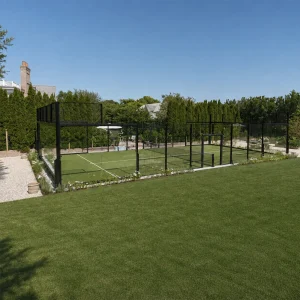
If you’re thinking about adding purchasing padel court, cost is probably one of the first questions on your list. But there is a problem with the way padel court pricing is usually discussed. You will often see a single number attached to the phrase “padel court cost.” That number can be useful for very early planning, but it doesn’t tell you what your own project will actually cost. The actual padel court is only one part of the project.
Your total investment can also depend on the site, foundation, drainage, electrical work, lighting, shipping, installation, permits, engineering, accessories, and the condition of the property where the court will be built. That’s why two facilities can purchase similar court systems and end up with very different project budgets.
The better question isn’t simply, “How much does a padel court cost?”. It’s “What will I need to budget for to build the right padel court at my site?”.
This guide walks through the decisions and costs you should understand before requesting quotes, comparing Sportsfield Specialties to other manufacturers, or committing to a specific court system.
What’s Included in the Cost of a Padel Court?
Before comparing prices, you need to know what you’re actually comparing. A padel court is a complete playing environment made up of several components.
Depending on the court system, that can include:
- Structural steel framing
- Glass panels
- Mesh panels
- Net posts
- Net
- Synthetic turf
- Lighting
- Hardware and anchors
- Finishes
- Other court-specific components
For example, Sportsfield Specialties’ PaDelhi™ padel court systems are supplied as complete systems with structural framing, tempered glass, mesh, net posts and netting, synthetic turf, and lighting. We offer both indoor full panoramic and outdoor panoramic configurations. That distinction matters when you compare suppliers. We also offer padel court padding and locking gate systems.
One manufacturer may quote a court system that includes several components another supplier treats as upgrades or separate purchases. So don’t compare the number at the bottom of two quotes until you compare what is included in each quote.
A Better Way to Compare Quotes
Ask each manufacturer to identify:
What’s Included
- Court structure
- Glass
- Mesh
- Turf
- Net system
- Lighting
- Hardware
- Accessories
What’s Not Included
- Foundation
- Site preparation
- Electrical service
- Drainage
- Permits
- Engineering
- Freight
- Installation
- Other site improvements
The goal is to get all suppliers talking about the same scope of work so everyone is on the same page.
Learn more: Explore PaDelhi™ Padel Court Systems
What Actually Determines Padel Court Cost?
There is no single factor that determines the cost of a padel court. Instead, several decisions work together.
The most important are:
- Where the court will be built
- Whether it is indoors or outdoors
- How many courts you are building
- Which court configuration you choose
- What the site requires
- How the court will be installed
- What infrastructure already exists
- Which accessories and features you need
- What local codes and approvals require
Understanding these factors before you request a quote will help you get a much more useful answer from a manufacturer.
1. Start With the Site, Not the Court
This is one of the biggest mistakes first-time buyers make. They start by choosing a court and then try to figure out where it will go. The better approach is to evaluate the site first.
Before selecting a court system, find out:
- How much usable space is available?
- Is the site level?
- What is currently on the property?
- Is there an existing concrete surface?
- What are the soil conditions?
- What are the frost depths
- How will water drain?
- Where are the utilities?
- How will construction equipment reach the site?
- Are there buildings, trees, poles, or other obstacles nearby?
- What zoning or permitting requirements apply?
- What are local labor costs?
A manufacturer can provide a well-engineered court, but the court still has to work with the property.
Try This Before Requesting Quotes
Create a simple site information package.
Include:
- Property address
- Site plan, if available
- Photos
- Approximate dimensions
- Existing pavement or concrete information
- Utility locations
- Access information
- Desired number of courts
- Indoor or outdoor preference
- Target construction timeline
You don’t need to have every answer before contacting a manufacturer. But the more useful information you can provide, the easier it is to have a productive conversation about your project.
Sportsfield Specialties works with owners, architects, contractors, schools, clubs, and municipalities on padel projects and provides project support from design through installation coordination.
2. Indoor vs. Outdoor Padel Courts
The location of the court could have a major effect on the project. But it isn’t as simple as saying indoor courts cost more or outdoor courts cost less. The existing property matters.
Indoor Courts
An indoor project may allow you to use an existing building, which can eliminate some outdoor site work. But you still need to determine whether the building is suitable.
Look at:
- Available floor space
- Clear ceiling height
- Floor condition
- Structural capacity
- Electrical service
- Lighting
- HVAC
- Fire and life-safety requirements
- Construction access
An existing building can be a major advantage if it already has the infrastructure you need.
It can also become expensive if significant modifications are required.
Sportsfield’s PaDelhi™ Indoor Full Panoramic system is designed for indoor facilities and uses large tempered glass panels, structural steel and aluminum components, synthetic turf, mesh, netting, and integrated LED lighting.
Learn more: See the PaDelhi™ Indoor Full Panoramic Padel Court System
Outdoor Courts
Outdoor projects introduce a different set of considerations.
You may need to address:
- Site grading
- Soil conditions
- Concrete foundation
- Drainage
- Electrical service
- Wind loads
- Weather exposure
- Frost
- Snow
- Construction access
Sportsfield’s PaDelhi™ Outdoor Panoramic system is professionally pre-engineered for specified wind conditions and incorporates structural steel, tempered glass, mesh, synthetic turf, lighting, and integrated drainage channels in portions of the court structure.
The important point is that the court system and the site are two connected but separate parts of the project. The court manufacturer designs the court. Your project team still needs to determine how the site will support and serve that court.
Learn more: See the PaDelhi™ Outdoor Panoramic Padel Court System
3. The Foundation Is Part of the Court Project
A padel court needs a suitable foundation. For an outdoor project, that often means a concrete slab or other engineered foundation system prepared specifically for the court. The exact requirements depend on the site and the court system.
Your project team may need to consider:
- Soil conditions
- Excavation
- Subgrade preparation
- Frost depth
- Reinforcement
- Concrete specifications
- Drainage
- Elevation
- Anchoring
- Local building requirements
- Access for equipment and trucks
This is one reason you should not ask a court manufacturer for a final project price before the site requirements are understood. A court can be manufactured to a consistent specification. Your site cannot.
What You Should Ask the Manufacturer
Ask for the manufacturer’s foundation requirements before your contractor prepares the slab. That gives the contractor the information needed to build the foundation around the actual court system rather than guessing.
Sportsfield provides product documentation, cut sheets, specifications, and installation information for its PaDelhi™ systems to support project planning and installation.
4. Site Preparation Can Change the Project
Imagine two properties that are exactly the same size. One is already level, has good access, suitable soil, nearby utilities, and an existing surface. The other requires excavation, grading, drainage improvements, utility work, and difficult equipment access. The courts may be identical. The projects will not be.
Site preparation can include:
- Clearing
- Demolition
- Excavation
- Grading
- Soil stabilization
- Base preparation
- Drainage
- Utility work
- Concrete work
- Landscaping
- Access improvements
This is why a court price by itself doesn’t tell you whether a project is affordable. The more work your property needs before the court can be installed, the less useful a generic “cost per court” estimate becomes.
Evaluate the site early. That will give you a much better basis for your project budget.
5. Don’t Forget Drainage
Water management deserves its own place in the planning process. Outdoor padel courts are exposed to rain, snow, ice, and changing temperatures. Water needs somewhere to go.
Before construction, determine:
- Where water currently flows
- Whether the site has existing drainage
- Whether the court area needs additional drainage
- Where runoff will discharge
- Whether surrounding grades need to change
- Whether local stormwater requirements apply
A court can include drainage features without solving every drainage problem on the property. That’s why court drainage and site drainage should be considered separately.
Sportsfield’s outdoor panoramic PaDelhi™ system includes integrated drainage channels in its bottom aluminum cross members, while the broader site still needs to be evaluated and designed for proper water management.
Learn more: Explore the PaDelhi™ Outdoor Panoramic system
6. Lighting and Electrical Work
Lighting is another area where buyers sometimes confuse the court system with the complete project. A court may include lighting fixtures and light posts. That does not necessarily mean your property is ready to power them.
You may also need:
- Electrical service
- Panels
- Conduit
- Wiring
- Trenching
- Disconnects
- Controls
- Electrical labor
- Inspections
Sportsfield’s PaDelhi™ court systems include dedicated lighting components, including LED fixtures and structural light posts. Before approving a quote, ask: “What part of the lighting and electrical work is included in this price?”
That one question can prevent a lot of confusion later.
7. Freight and Installation
A padel court is a large structural system. Getting it to your property and assembling it correctly are important parts of the project.
When comparing suppliers, find out:
- Who handles freight?
- Are there tarriffs?
- Where does delivery end?
- Who unloads the materials?
- What equipment is required?
- Who installs the court?
- Who installs the glass?
- Who installs the turf?
- Who handles final adjustments?
- What happens if the site isn’t ready?
- Who is responsible if materials are damaged during shipping?
Installation isn’t the place to assume that “someone will take care of it.” Get the responsibilities in writing.
Sportsfield’s padel division supports projects from planning and engineering through manufacturing and installation coordination. Sportsfield Specialties is quickly approaching its 100th padel court installation.
8. The Number of Courts Changes More Than the Number on Your Quote
Planning one court and planning a multi-court facility are very different exercises. If you’re considering multiple courts, look at the facility as a whole.
You may need to plan for:
- Court spacing
- Player circulation
- Spectator areas
- Walkways
- Parking
- Lighting
- Electrical infrastructure
- Drainage
- Landscaping
- Restrooms
- Reception
- Storage
- Seating
- Future expansion
Some costs increase with every court. Others are shared across the facility. That means adding another court doesn’t necessarily mean adding the exact same amount of work and infrastructure.
Think About Future Expansion
If you ultimately want four courts but can only build two today, consider whether the site plan should account for future courts.
Think about:
- Electrical capacity
- Drainage
- Access
- Court spacing
- Utilities
- Walkways
- Future construction access
Planning for expansion early can be much easier than trying to redesign the property later.
9. Court Configuration Matters
Not every padel court is built the same way.
The configuration you choose can affect:
- Structural design
- Glass requirements
- Steel requirements
- Visibility
- Spectator experience
- Installation
- Appearance
- Facility layout
For example, Sportsfield offers both indoor full panoramic and outdoor panoramic PaDelhi™ systems. The full panoramic design is intended to maximize sightlines by using expansive glass panels where traditional rear corner posts would otherwise be located. That doesn’t mean one configuration is automatically better than another. It means you should choose the court based on how you plan to use the facility.
Ask yourself: Is this primarily…
- A recreational court?
- A commercial club?
- A resort amenity?
- A school facility?
- A municipal facility?
- A competition venue?
- A show court?
- A private court?
The answer can influence which features are worth prioritizing.
10. Materials Matter More Than the Brochure Photo
A padel court can look great in a photograph. That tells you very little about how it is built. When comparing court systems, look at the actual specifications.
Ask about:
Structural steel
- What sizes and thicknesses are used?
- How are components connected?
- How are critical joints reinforced?
Glass
- What type of glass is used?
- What thickness is it?
- How is it supported?
Mesh
- What gauge and configuration is used?
- How is it framed and connected?
Turf
- What type of turf is included?
- What is the pile height?
- How is it installed?
- What infill is used?
Finish
- What coating protects the structural components?
How is the finish intended to perform in the environment where the court will be installed? These details tell you much more than a generic statement such as “premium materials.”
For example, Sportsfield publishes detailed specifications for its PaDelhi™ systems, including structural member sizes, glass specifications, mesh construction, turf specifications, anchors, finishes, and lighting components.
11. Accessories Are Part of the Finished Facility
Accessories may not represent the largest part of your project, but they can matter to the way the court operates. Think about how people will actually use the facility.
Will you need:
- Player protection?
- Controlled court access?
- Branding?
- Additional signage?
- Seating?
- Storage?
- Equipment?
- Maintenance supplies?
Court Padding
Padel is played in a compact enclosed space, and players move quickly around structural elements. Sportsfield’s PaDelhi™ entrance, exit, and net post padding uses impact-absorbing foam with a durable vinyl exterior and is designed for high-contact areas around the court.
Learn more: See PaDelhi™ Padel Court Padding
Locking Gates
A facility may also need controlled access when courts are not being used. A locking gate can help manage who enters the court and how people move through the facility. Sportsfield offers a sliding locking gate system designed for PaDelhi™ court configurations.
Learn more: See PaDelhi™ Padel Court Locking Gates
12. Permits and Engineering Are Part of the Project
Before construction begins, determine what your local jurisdiction requires.
Depending on the property and project, you may need:
- Site surveys
- Civil engineering
- Structural engineering
- Building permits
- Electrical permits
- Zoning approval
- Inspections
- Stormwater review
- Local code documentation
There is an important distinction here. The court manufacturer’s engineering is not necessarily the same thing as the engineering required for your entire property. A manufacturer may engineer the court system for specific structural and environmental requirements.
Your local project team may still need to engineer:
- The foundation
- Site grading
- Drainage
- Utilities
- Electrical work
- Other site improvements
Ask your court manufacturer what technical documentation they can provide to your architect, engineer, and contractor.
How to Build a Padel Court Project Budget
Once you understand the major components, you can build a much more useful budget. Don’t start with one big number. Break the project into categories.
Court System
- Court structure
- Glass
- Mesh
- Turf
- Net system
- Lighting
- Hardware
Site
- Survey
- Site preparation
- Excavation
- Foundation
- Drainage
- Landscaping
Construction
- Freight
- Unloading
- Installation
- Equipment rental
- Contractor labor
Infrastructure
- Electrical service
- Electrical installation
- Utilities
- Walkways
- Access
Professional Services
- Engineering
- Architecture
- Permitting
- Inspections
Facility
- Seating
- Player areas
- Reception
- Storage
- Restrooms
- Parking
- Signage
Accessories
- Padding
- Locking gates
- Branding
- Other equipment
Long-Term Ownership
- Maintenance
- Cleaning
- Replacement components
- Repairs
- Turf maintenance
- Lighting maintenance
Then add an appropriate contingency for unknown site or construction conditions. This gives you something far more useful than a generic “cost per court.” It gives you a project budget.
How to Compare Padel Court Quotes
Once you have multiple proposals, don’t immediately choose the lowest number. Put the proposals side by side.
Create a simple comparison with these categories:
| Category | Manufacturer A | Manufacturer B | Manufacturer C |
| Court structure | |||
| Glass | |||
| Mesh | |||
| Turf | |||
| Net system | |||
| Lighting | |||
| Hardware | |||
| Freight | |||
| Installation | |||
| Foundation requirements | |||
| Engineering support | |||
| Warranty | |||
| Replacement parts | |||
| Tech documentation | |||
| Customer support | |||
| What’s excluded? |
Then ask the most important question: “What isn’t included?”
An apparently inexpensive quote may simply have more project responsibilities left to you. You want to compare complete scope, not just purchase price.
What Should You Ask a Padel Court Manufacturer?
Before selecting a manufacturer, ask questions that help you understand both the product and the project.
About the Court
- What exactly is included in the court system?
- What materials are used?
- What are the glass specifications?
- What are the structural specifications?
- What turf is included?
- Is lighting included?
- What court configurations are available?
About the Site
- What foundation does the court require?
- What site information do you need before providing a quote?
- What drainage requirements should we consider?
- What environmental or wind-load requirements apply?
About Installation
- Who installs the court?
- Is installation included?
- Who handles freight?
- Who unloads the materials?
- What equipment is required?
- What does the contractor need to complete before installation?
About Ownership
- What is covered by the warranty?
- How are replacement components ordered?
- Who provides technical support after installation?
- What maintenance does the court require?
- What should we expect over the life of the court?
A manufacturer that can answer these questions clearly is helping you make a better purchasing decision. That’s valuable.
Where Should You Spend More?
If your project has a fixed budget, you will eventually have to decide what matters most. Start with the things that affect safety, structural performance, durability, installation, and long-term ownership.
That can include:
- Proper site preparation
- Foundation
- Drainage
- Structural engineering
- Quality materials
- Correct installation
- Appropriate lighting
- Player safety
- Long-term manufacturer support
These are areas where a short-term saving can create a much larger problem later.
Where Can You Potentially Simplify the Project?
Cost control doesn’t always mean buying a cheaper court. Sometimes the better approach is to simplify the project around the court.
For example:
Use a Better Site
A site with good access and existing infrastructure may reduce construction complexity.
Use Existing Infrastructure
An existing building, slab, electrical service, or other infrastructure may reduce the amount of new construction required.
Build the Right Number of Courts
More courts aren’t necessarily better if they don’t match your expected demand.
Plan Before Construction
Changing a design after construction starts is usually more complicated than resolving the issue during planning.
Separate Must-Haves From Nice-to-Haves
Identify the features that directly support:
- Player safety
- Court performance
- Facility operations
- Revenue
- Long-term durability
Then prioritize everything else.
What Should You Never Do to Save Money?
Don’t cut corners on things that affect the fundamental performance of the court or the property.
Be especially careful about reducing the scope of:
- Foundation preparation
- Structural engineering
- Drainage
- Electrical work
- Installation
- Safety features
- Required permits
- Code compliance
A court that is inexpensive to purchase but difficult to operate or maintain isn’t necessarily an inexpensive court. Think about the entire ownership period, not just the day you sign the purchase order.
What Does a Padel Court Cost Over Its Lifetime?
The initial purchase is only one part of the financial decision. If you’re operating a club, school, resort, municipality, or other facility, you should also think about ongoing ownership.
That can include:
- Routine cleaning
- Turf maintenance
- Glass cleaning
- Net replacement
- Hardware inspection
- Lighting maintenance
- Gate maintenance
- Padding replacement
- Repairs
- Replacement components
Ask manufacturers about these requirements before you buy. A court that is easy to maintain and supported by an established manufacturer may offer more value over time than a system that simply looks attractive on an initial quote. This is also why manufacturer support matters.
Sportsfield Specialties has been manufacturing sports construction equipment since 1998 and has a dedicated Padel Sales Division. We are fast approaching our 100th padel court installation in the United States.
When Should You Contact a Padel Court Manufacturer?
Earlier than you might think. You don’t need a finished architectural plan before starting a conversation.
If you know:
- Where you want to build
- Approximately how much space you have
- How many courts you’re considering
- Whether they will be indoors or outdoors
- What type of facility you are planning
- Your approximate timeline
…you have enough information to begin discussing the project. An experienced manufacturer can help identify questions you may not have considered yet. That can be especially useful before you finalize the site plan or foundation design.
Sportsfield Specialties works with owners, architects, contractors, and developers to help plan padel projects from design through installation. The company manufactures its PaDelhi™ Padel Court Systems in the U.S. and provides indoor and outdoor court options.
Learn more: Talk with the Sportsfield Specialties Padel Sales Team
Bottom Line: Padel Court Cost
There isn’t one number that accurately answers, “How much does a padel court cost?” The better answer is: it depends on the court, the site, the facility, and everything required to turn the site into a finished, playable court.
Before comparing quotes, understand:
- What the court system includes
- What the site requires
- What the foundation requires
- How drainage will be handled
- What electrical work is needed
- How the court will be delivered
- Who will install it
- What permits and engineering are required
- Which accessories make sense
- What support you’ll receive after installation
Then compare manufacturers based on the complete scope, specifications, support, and long-term value, not just the initial price.
If you’re planning a new padel court, you don’t need to have every detail figured out before you start. A conversation with an experienced court manufacturer can help you identify the questions that need to be answered and determine what information is needed to develop a realistic project plan.
If you’re ready to start planning, Sportsfield Specialties can help you explore the right PaDelhi™ court system for your facility and work through the requirements of your project. Contact our Padel Sales Division to learn more about the cost of padel courts.