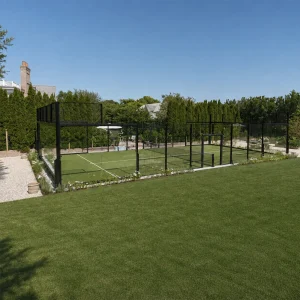
Managing one padel court is fairly straight forward. Managing several courts requires a different approach. Once a facility has four, six, eight, or more courts, maintenance becomes an ongoing concern. With multiple courts, you need more than just a list of maintenance tasks. You need a system that tells your staff which courts were inspected, what needs attention, which repairs can wait, and which problems require a court to be taken out of service. This is important because courts don’t always wear at the same rate.
One court might be used for lessons and leagues every day. Another might have fewer bookings. Outdoor courts may also have different exposures to sun, rain, wind, trees, and debris depending on where they’re located. That makes a consistent padel court maintenance plan important for any multi-court facility.
A good multi-court maintenance program should help your facility:
- Keep courts safe and playable
- Maintain consistent playing conditions
- Catch problems early
- Reduce unnecessary court closures
- Schedule work around court bookings
- Track repairs and replacement parts
- Identify recurring problems
- Plan for future maintenance costs
The best program doesn’t treat every court exactly the same. It gives every court a baseline level of care, then adjusts the work based on use, condition, and environment.
The good news is that managing multiple courts doesn’t have to be complicated. With clear procedures, regular inspections, and a well-trained staff, facilities can keep every court safe, clean and playable.
Standardize Your Maintenance Program
Before deciding how often to maintain your padel courts, decide what “ready for play” means for your facility. Every court should meet the same basic standard when it opens.
That might include:
- Playing surface is clean and in good condition
- Glass has no visible damage
- Structural components appear secure
- Mesh is in good condition
- Net is properly installed and in good condition
- Gate operates correctly
- Padding is secure, where installed
- Lighting is operating as expected
- Court surroundings are clean
- No obvious safety concerns are present
This gives your staff a clear baseline. Without one, different employees may have different ideas about what needs to be cleaned or fixed. One person may close a court because a gate is becoming difficult to operate. Another might leave it open until the gate stops working completely. A written standard removes some of the guesswork.
Create one maintenance program that applies to every court unless a specific court requires additional attention. Your standard program should include daily inspections, weekly cleanings, monthly structural inspections, seasonal maintenance and annual reviews. Use the same procedures across every court makes training easier and creates more consistent playing conditions.
Make the Standard Easy to Use
Don’t create a 40-point inspection form for a task that needs to happen before the first court booking of the day. Separate your maintenance program into two parts. Create a quick operational checklist asking if the court is ready to use. Then create a detailed maintenance inspection that asks what condition the courts and its components are in.
Create Individual Maintenance Records
Number every court. Even if every court follows the same maintenance schedule, each court should have its own maintenance history. You don’t need specialized software to do this. A spreadsheet can work for a smaller facility. Larger clubs may prefer a maintenance or work-order system. The important thing is that the information is easy to find.
Track information such as:
- Inspection dates
- Maintenance performed
- Problems reported
- Repairs completed
- Parts replaced
- Court closures
- Downtime
- Turf condition
- Gate problems
- Lighting issues
- Drainage problems
- Notes from staff
After six months, the records should tell you more than whether a repair was completed. They should help you understand how each court is performing, improve budgeting and planning future maintenance. Separate records make it easier to identify recurring problems on specific courts.
For example, you may discover that Court 3 has had four gate repairs while the other courts have had none. That’s a reason to investigate. Maybe the court gets more traffic. Maybe the gate is being used differently. Maybe the hardware needs attention. The maintenance history gives you a starting point.
Don’t Give Every Court the Same Maintenance Schedule
A common mistake with multi-court padel facilities is creating one schedule and applying it to every court without looking at its actual use. Instead, start with three questions:
How Much is the Court Used?
Look at booked hours, lessons, leagues, tournaments, events, open play, and member reservations. A court used 70 hours a week will likely need more attention than one used only 20 hours a week.
What is the Court Exposed to?
Indoor and outdoor courts have different sets of environmental factors. Indoor courts may be protected from direct weather, but they’re not maintenance-free. Outdoor courts may also need additional attention after heavy rain or a storm.
For outdoor courts, consider: rain, wind, sun, snow and ice, leaves, grass clippings, nearby trees, drainage conditions and player traffic.
For indoor courts, you’ll want to consider: temperature, humidity, condensation, dust, HVAC airflow, building leaks, lighting, player traffic, and other activities in the building.
What Does the Court’s History Show?
Look for repeated repairs, faster turf wear, gate problems, lighting issues, drainage problems, damaged padding, and other recurring maintenance needs.
Schedule Maintenance Around Court Bookings
This is where multi-court maintenance becomes an operations issue. A busy facility can’t simply close all of its courts every time a court needs maintenance. Instead, build maintenance windows into your booking schedule.
For example, if Court 4 has the fewest bookings on Tuesday mornings, that may be a better maintenance window than Friday evenings. This doesn’t mean every maintenance task needs to happen during a fixed weekly window. It just means your operations team should know when your courts are available for maintenance without unnecessarily reducing court capacity.
Separate Routine Work From Disruptive Work
Some tasks can happen while the facility is operating, others may require a court to be closed temporarily.
Short Maintenance Tasks
- Remove debris
- Basic cleaning
- Visual inspections
- Checking gates
- Checking the net
- Recording issues
Tasks Requiring Maintenance Window
- Turf work
- Component replacements
- Structural repairs
- Glass work
- Gate repairs
- Lighting work
- Other technical repairs
The exact requirements depend on the work being performed. The point is to plan maintenance around court demand instead of treating court closures as an afterthought.
Use a Three-Level Maintenance System
When you manage several padel courts, every maintenance request can’t have the same priority. A simple three-level system can help.
Priority 1: Safety
These problems may require immediate action. Close the court when appropriate and have the problem evaluated.
Examples:
- Damaged glass
- Structural concerns
- Serious gate problems
- Unsafe playing conditions
- Exposed or hazardous components
- Other conditions that could put players at risk
Priority 2: Court Operation
These problems affect normal use but may not present an immediate safety concern. Schedule the repair promptly and determine whether the court should remain open.
Examples:
- Gate problems
- Net problems
- Significant turf wear
- Lighting problems
- Drainage concerns
- Damaged padding
Priority 3: Routine Maintenance
These issues can usually be handled during planned maintenance. Record the issue and schedule the work. This gives your staff a simple answer when several requests come in at once.
Examples:
- Minor finish damage
- Cosmetic issues
- Non-urgent wear
- Other maintenance items
Don’t Wait for Something to Break
Preventative maintenance is different from repairing a failed component. If a gate is already broken, you have a repair. If staff notice that the gate is becoming harder to operate and report it early, you have an opportunity to address the problem before it affects court availability.
The same thinking applies to other court components.
Wait for changes in:
- Turf condition
- Net condition
- Gate operation
- Padding
- Glass
- Steel and mesh
- Hardware
- Lighting
- Drainage
You don’t need to replace something simply because it shows normal wear. You do need a way to recognize when a change deserves attention though. That’s why maintenance records are so useful.
Treat the Playing Surface as a High-Use Asset
The synthetic turf takes constant player traffic, so it deserves regular attention. But don’t manage every court based only on a calendar. Look at the condition of each court surface.
Check for:
- Heavy wear in high-traffic areas
- Changes in turf appearance
- Damaged seams
- Loose areas
- Uneven or depleted sand infill
- Debris
- Areas that look different from the rest of the court
Then compare courts. If Court 2 has twice as many bookings as Court 7, it’s reasonable that the surfaces may show different levels of wear. That’s useful information, but not necessarily a problem.
Sportsfield Specialties’ PaDelhi™ court systems include synthetic turf as part of our court system. For any brushing, cleaning, infill management, or other playing-surface maintenance, follow the requirements for the specific court and turf system.
Inspect the Court as a Complete System
A padel court isn’t just the turf, glass or steel structure. A maintenance inspection should consider the complete padel court system Depending on the design, that can include:
- Glass panels
- Steel frame
- Mesh
- Hardware components
- Net and net posts
- Gates
- Padding
- Lighting
- Playing surface
- Surrounding site
Sportsfield Specialties’ PaDelhi™ court systems include synthetic turf as part of the court system. Current product documentation also identifies sand infill as part of the system.
For any brushing, cleaning, infill management, or other playing-surface maintenance, follow the requirements for the specific court and turf system. That matters when you’re managing several courts. Staff don’t need to be structural engineers. They do need to know what normal looks like and when something should be reported.
Look for Changes
The goal of a routine padel court inspection isn’t to find a reason to repair something. It’s to notice when something has changed. A component that looks different from the previous inspection deserves a closer look.
Examples include:
- A gate that doesn’t move normally
- A loose-looking component
- Damaged mesh
- A cracked or damaged glass panel
- Padding that’s moved
- A change in turf condition
- Lighting problems
- Water collecting where it shouldn’t
When in doubt about a structural or technical issue, follow the manufacturer’s guidance and involve qualified personnel.
Track Court Downtime, Not Just Repairs
This is one of the most important differences between maintaining one court and managing a multi-court padel facility. Repairs have a cost and so does a closed court.
If Court 4 is unavailable, you may lose bookings, lessons, league play, tournament capacity, member access or revenue. So track downtime.
For every court closure, record the court number, date and time closed, reason for closure, repair required, date and time reopened, and total downtime. Then review this information. You may find that one type of repair is responsible for most of your lost court hours. That’s more useful than simply knowing how much you spent on repairs.
Give Every Employee a Simple Reporting Process
Maintenance problems don’t always start with the maintenance team. A coach may notice a damaged gate, a front desk employee may hear that player noticed a problem, or a court monitor may see water collecting somewhere it shouldn’t after a heavy storm. Give everyone the same way to report it.
A useful report should include:
- Court number
- Component
- Problem
- Date and time
- Photo, when useful
- Whether the court remains open
- Immediate action taken
Keep Reporting Simple
If reporting a problem takes five minutes, staff may put it off and eventually forget about it entirely. If they can scan a QR code, select a court number, choose the problem, add a note, and attach a photo, you’re more likely to get useful reports. The exact system doesn’t matter.
The goal is to make reporting easy enough that problems get documented while they’re still small and easy to address.
Keep Replacement Parts and Maintenance Supplies Organized
A multi-court padel facility has more equipment in service, so replacement parts become an operational issue. Keep an inventory of the parts and supplies your facility may need and store them in a dedicated location.
Don’t replace court-specific components with generic parts simply because they appear similar. Use the manufacturer’s replacement guidance. This is especially important for components that are part of the court’s structural or safety systems.
Sportsfield Specialties maintains product documentation for our PaDelhi™ systems and other sports construction equipment, giving project teams access to current technical information.
Use Maintenance Data to Find Problems that Repeat
A maintenance log becomes much more valuable when you start looking for patterns.
Once you have several months of data, ask:
- Which court has the most repairs?
- Which court has the most downtime?
- Which component needs attention most often?
- Which courts show the most turf wear?
- Are certain problems tied to heavy usage?
- Do outdoor problems increase after certain weather?
- Are the same repairs happening repeatedly?
- Are some courts consistently harder to maintain?
The answers can change how you manage the facility. The goal is to understand the reason behind recurring maintenance, not just count repairs.
Use Maintenance Data to Plan Future Spending
Maintenance records can also help with budgeting.
Instead of waiting for something to fail, look at what your facility has actually spent on:
- Repairs
- Replacement parts
- Turf maintenance
- Lighting
- Gate repairs
- Padding
- Cleaning
- Professional service
- Court downtime
Then look for trends. If a particular type of component consistently requires attention, include that in future budgets. If a court has much higher maintenance costs than the others, investigate why. If your facility is planning additional courts, the information from your existing courts can also help you plan staffing, maintenance supplies, and operating costs.
This is one of the biggest benefits of treating maintenance as an ongoing facility operation rather than a series of isolated repairs.
Build Maintenance Into Your Facility Expansion Plans
If you’re planning to add courts later, don’t only think about where the new courts will fit. Think about how they’ll be maintained.
Consider:
- Staff travel between courts
- Equipment storage
- Cleaning equipment access
- Maintenance vehicle access
- Replacement part storage
- Lighting access
- Drainage
- Landscaping
- Court numbering
- Electrical access
- Court closures during maintenance
A layout that looks good on a site plan may not be the easiest layout for staff to maintain. Maintenance access is a facility planning issue. It should be considered before the next court is installed.
Sportsfield Specialties works with owners, architects, contractors, and developers on padel projects and can support projects ranging from individual courts to larger facilities. Its current PaDelhi™ product line includes indoor and outdoor court systems and compatible accessories.
Create a Maintenance Calendar That Fits Your Facility
There isn’t one maintenance schedule that works for every padel facility.
Your schedule should reflect:
- Number of courts
- Court usage
- Indoor or outdoor location
- Climate
- Court condition
- Manufacturer recommendations
- Staff availability
- Facility operating hours
A basic framework might look like this:
| Frequency | Main Focus |
| Before opening | Quick safety and condition check |
| Daily | Address reported problems and keeps court clean |
| Weekly | More detailed court inspection |
| Monthly | Review components, repairs, downtime, and recurring problems |
| After severe weather | Inspect outdoor courts and surrounding areas |
| Seasonally | Review weather-related conditions and maintenance needs |
| As needed | Corrective repairs and professional service |
This is a framework, not a universal maintenance requirement. The manufacturer’s recommendations for the specific court system should guide your actual maintenance procedures.
Don’t Forget the Area Between the Courts
Multi-court facilities create a larger shared environment. Maintenance staff aren’t only maintaining the courts. They’re maintaining the space between them.
Pay attention to:
- Walkways
- Court entrances
- Drainage areas
- Landscaping
- Lighting
- Seating
- Trash
- Equipment storage
- Signage
- Access routes
This matters outdoors in particular. Leaves, branches, glass clippings, and other debris can move from surrounding areas onto the playing surface. The more courts you have, the more important it becomes to think about the facility as one maintenance area rather than a collection of isolated courts.
Managing Multiple Padel Courts Is an Operations Job
The biggest mistake a multi-court facility can make is treating maintenance as something that happens when a court has a problem. A better approach is to build maintenance into the way the facility operates.
Give every court a maintenance history. Set a clear standard for what makes a court ready for play. Schedule maintenance around bookings. Prioritize repairs based on safety and operational impact. Track downtime. Keep replacement parts organized. Then use the information you collect to find recurring problems and plan future work.
The number of courts doesn’t have to make maintenance complicated. It makes consistency more important.
Sportsfield Specialties has built its PaDelhi™ product line around complete padel court systems, including indoor full panoramic and outdoor panoramic courts, with compatible accessories such as entrance/exit and net post padding and sliding locking gate systems. We also provide technical documentation and support projects through planning, engineering, manufacturing, and installation.
For a facility with multiple courts, those conversations are worth having before the courts are installed. Maintenance is easier to manage when the people responsible for operating the facility understand the court system, the accessories, the site, and the level of use from the start.