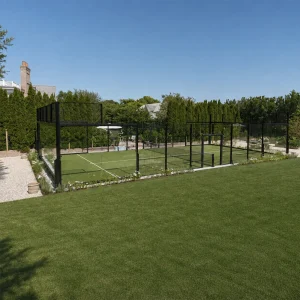
Most padel court problems don’t start as major problems. They usually start with a change that isn’t noticed or isn’t addressed. A small area of turf begins to wear. A gate doesn’t move as smoothly as it used to. Water starts sitting near the court after it rained. A piece of hardware loosens. A section of padding gets damaged.
The court may still be usable. That’s when its easiest to ignore the problem.
Regular maintenance can’t prevent every repair. Courts are exposed to player use, weather, cleaning, and normal wear. But a good maintenance program can help you catch changes early and reduce the chance of small problems turning into larger ones.
It also helps to understand where problems come from. Some are related to normal wear. Others can be caused by weather, site conditions, installation, cleaning methods, or how the court is used.
Here are some of the most common padel court problems facility owners should watch for and what you can do to help prevent them.
Worn or Damaged Artificial Turf
The playing surface takes a lot of use. Players are constantly starting, stopping, turning, and changing direction. Over time, areas that receive the most traffic can show more wear than the rest of the court.
You may notice:
- Flattened or worn areas
- Loose or damaged seams
- Changes in the appearance of the turf
- Areas with less or uneven infill
- Damaged court lines
- A noticeable difference between high-use and low-use areas
Not every change means the turf needs to be replaced. The important thing is to notice changes early and track how they develop.
What Causes Turf Problems?
Several factors can contribute to turf wear, including court usage, cleaning methods, debris, weather, installation, and normal aging. A court that’s booked from morning through late evening will naturally experience more wear than one that’s used occasionally.
Outdoor courts also face environmental conditions that indoor courts don’t.
How to Help Prevent Turf Problems
Start with regular cleaning and inspection. Don’t wait until the turf looks badly worn. Compare the condition of the playing surface over time and pay attention to areas that are changing faster than the rest of the court.
Use the cleaning methods recommended for the specific turf system. Don’t assume that a cleaning method used on another type of synthetic sports surface is appropriate for padel turf.
Sportsfield Specialties’ PaDelhi™ court systems use polypropylene synthetic turf with inlaid court lines. The current product documentation identifies a 9/16-inch pile height with a tolerance of plus or minus 1/8 inch.
If you’re seeing unusual wear, don’t automatically blame the turf. Look at court usage, cleaning, installation, and the surrounding conditions too.
Damaged or Cracked Glass
Glass is one of the most important components of a padel court, and damage should be taken seriously. A chip, crack, or other visible change may be easy to overlook during a busy day, especially when players are focused on the game.
Don’t.
What Should You Look For?
During routine inspections, look for:
- Cracks
- Chips
- Damage around glass edges
- Changes near mounting points
- Anything that looks different from previous inspections
A damaged glass panel isn’t something facility staff should try to repair themselves.
How to Help Prevent Glass Problems
Regular visual inspections are the first step. Clean glass also makes it easier to spot damage, which is another reason cleaning and inspection work together. If glass damage is found, follow the court manufacturer’s instructions and have the appropriate qualified person evaluate it. If there’s a question about whether the court is safe to use, keep players away from the affected area until the issue has been evaluated.
Sportsfield Specialties’ PaDelhi™ court systems use tempered glass as part of the court structure. The current indoor full panoramic system uses 12mm clear tempered glass, while the company’s broader PaDelhi™ product documentation includes different configurations.
The important point isn’t the glass thickness alone. It’s making sure the glass system is installed, inspected, and maintained according to the requirements of the specific court.
Loose, Damaged, or Corroded Structural Components
A padel court isn’t just glass and turf. The court structure includes steel posts, framing, mesh, brackets, base plates, hardware, and other components that work together. Problems with these components can be harder to notice because they’re not always in the areas players look at during normal play.
Watch for:
- Loose hardware
- Visible damage
- Corrosion
- Changes in alignment
- Damaged mesh
- Unexpected movement
- Components that look different from previous inspections
What Causes Structural Problems?
Normal use can contribute to wear, but other factors can matter too. Outdoor courts are exposed to weather and moisture. Installation quality matters. Site conditions matter. So does the condition of protective finishes. This is one area where maintenance has limits.
If a structural component wasn’t installed correctly or the site isn’t suitable for the court, routine cleaning won’t fix the underlying problem.
How to Help Prevent Structural Problems
Inspect the complete court structure, not just the parts players see. For outdoor courts, pay particular attention to moisture and corrosion. If a component appears loose, damaged, or out of alignment, don’t simply tighten or modify it without knowing what the manufacturer recommends. Structural components are part of an engineered system.
Sportsfield Specialties’ PaDelhi™ systems use welded steel structural components and engineered connections. Its outdoor panoramic system is professionally pre-engineered for specified ASCE 7 wind loads, which is one reason site conditions and proper installation matter from the beginning.
Drainage Problems and Standing Water
Drainage is one of the easiest parts of an outdoor padel facility to overlook. You may not notice a problem on a dry day. Then a heavy storm comes through.
Water collects around the court or takes much longer than expected to drain. Leaves and debris may be blocking a drainage path. Or the problem may be related to the surrounding site rather than the court itself.
Warning signs
Look for:
- Standing water
- Water that repeatedly collects in the same location
- Slow drainage after rain
- Blocked drainage areas
- Soil or surface movement
- Changes in the surrounding grade
How to Help Prevent Drainage Problems
Pay attention after significant rainfall. Keep drainage areas and surrounding surfaces clear of leaves and debris. If water repeatedly collects in the same place, don’t keep treating it as a cleaning problem.
The underlying drainage or site conditions may need to be evaluated.
This is also why drainage should be addressed during the original facility design. The court, foundation, surrounding surfaces, and site drainage need to work together.
Gates That Stick, Drag, or Don’t Close Properly
Court gates get used a lot. Players use them. Staff use them. Equipment may pass through them. At a busy facility, that can mean hundreds of operations over time. A gate that starts sticking or dragging is worth addressing before it becomes unusable.
Warning signs
Pay attention if:
- The gate becomes harder to open
- The gate doesn’t close completely
- The locking mechanism doesn’t operate properly
- The gate is dragging
- Hardware appears loose
- Something is interfering with the track or movement
How to help prevent gate problems
Include gates in routine inspections. Don’t force a gate that isn’t operating properly. Determine what’s causing the problem and follow the manufacturer’s recommendations for adjustment or repair.
Sportsfield Specialties offers the PaDelhi™ Entrance/Exit Sliding Locking Gate System as part of its padel court accessory line. The sliding design provides controlled court access without a traditional swing gate extending into the surrounding area.
The gate is part of the facility’s daily operation, so it should be treated as part of the court maintenance program.
Damaged Court Padding
Padding is often installed around areas where players may come into contact with court components, including entrances, exits, and net posts. It’s there to provide an added layer of protection. But padding is still a component that needs to be inspected.
Look for:
- Torn vinyl
- Loose attachment
- Exposed foam
- Gaps
- Movement
- Damage from repeated contact
How to help prevent padding problems
Include padding in the same inspection process as the rest of the court. Don’t wait until the padding is falling apart.
Sportsfield Specialties offers PaDelhi™ Entrance/Exit and Net Post Padding for its court systems. The current product line identifies this as a dedicated padel court accessory rather than something added from a general padding product category.
If padding is damaged, determine whether it can be repaired or needs to be replaced based on its condition and the manufacturer’s recommendations.
Net and Net Post Problems
The net may be one of the simplest components on the court, but it still needs attention. A net can become damaged or change in tension over time. Hardware around the posts can also require inspection.
Watch for:
- Damaged netting
- Changes in net tension
- Loose hardware
- Damage around the posts
- Components that appear out of position
How to Help Prevent Net Problems
Include the net and posts in routine inspections. If something doesn’t look or operate as it normally should, record the issue and follow the manufacturer’s maintenance guidance.
The PaDelhi™ court system includes padel court posts and net components as part of the complete court system.
Corrosion and Damage to Protective Finishes
Outdoor courts have another problem to watch for: moisture. Over time, exposure to rain, humidity, snow, ice, and other environmental conditions can affect metal components and their protective finishes. The first sign may be small. You might see a scratch, exposed metal, discoloration, or a small area of corrosion.
How to Help Prevent Corrosion
During inspections, look closely at:
- Steel framing
- Posts
- Base plates
- Hardware
- Areas where moisture can collect
- Damaged or worn finishes
If you find corrosion, don’t simply cover it up. The right response depends on the location, severity, component, and manufacturer’s recommendations. The environment also matters. An outdoor court in a wet or coastal area may have different maintenance needs from one in a dry climate.
Sportsfield Specialties’ PaDelhi™ outdoor court system uses powder-coated steel components and is engineered for specified wind conditions.
Lighting Problems
Lighting affects how and when a facility can operate. A lighting problem may be obvious when a fixture stops working, but other issues can develop before a complete failure.
Watch for:
- Lights that don’t operate
- Damaged fixtures
- Uneven lighting
- Visible damage to components
- Electrical problems
How to Help Prevent Lighting Problems
Include lighting in routine visual inspections. Don’t attempt electrical repairs unless you’re qualified and authorized to perform them. Electrical problems should be handled by the appropriate professional.
Sportsfield Specialties’ PaDelhi™ court systems include integrated LED lighting as part of the court system. Current PaDelhi™ documentation identifies four 400-watt LED fixtures in the listed system configurations.
Because lighting is part of the court system, the facility team should understand the manufacturer’s requirements before changing or repairing components.
Excessive Debris on the Court
Debris may seem like a simple cleaning issue, and often it is. But excessive debris can also make it harder to see developing problems. Leaves, pollen, dirt, sand, and other material can collect on the playing surface and around the court. Outdoor courts are more exposed to this problem, especially when they are located near trees or landscaping.
How to Help Prevent Debris Problems
Build cleaning into the normal operating schedule. The right frequency depends on court usage and local conditions. A court surrounded by trees may need more frequent attention during certain seasons. A busy indoor facility may need frequent cleaning because of player traffic.
Don’t wait until the court looks neglected.
Problems Caused by Heavy Court Use
Sometimes a court problem isn’t caused by poor maintenance. It’s caused by a lot of use. A court that’s booked all day will experience more player traffic than one used a few times each week. That can affect turf wear, gate operation, cleaning needs, and how often the court should be inspected.
How to Help Prevent Use-Related Problems
Track court usage when you can. You don’t need a complicated system. Your booking software may already tell you how often each court is being used. Use that information to identify high-use courts and give them the attention they need.
This is particularly important for multi-court facilities. If one court consistently experiences more wear than the others, investigate the reason instead of assuming something is wrong with the product.
When a Court Problem Is Not a Maintenance Problem
This is an important distinction for facility owners. Maintenance can help protect a court, but it can’t correct every underlying issue.
For example, recurring standing water may point to a site or drainage problem. Unusual structural movement may require an engineering or installation review. A component that repeatedly fails may need to be investigated rather than replaced over and over. Excessive turf wear may be related to usage, installation, cleaning, or another condition.
When a problem keeps coming back, ask:
Are we fixing the symptom or finding the cause?
That question can save time and money. If the problem involves the court’s structural performance, installation, site conditions, or a component that isn’t behaving as expected, involve the manufacturer and the appropriate qualified professional.
Problems Are Easier to Prevent When You Track Them
A maintenance log isn’t just a record of work that has already been done. It can show you what is happening to the court over time.
For each court, record things such as:
- Inspection dates
- Problems found
- Repairs
- Replacement components
- Court downtime
- Weather-related issues
- Repeated problems
This becomes especially valuable when you have multiple courts. If Court 4 repeatedly needs gate repairs, that’s information worth reviewing. If Court 2 shows much more turf wear than the other courts, look at its usage and conditions.
If several outdoor courts develop the same drainage problem after heavy rain, look beyond the individual court. Patterns can tell you more than individual repairs.
What Should You Do When You Find a Serious Problem?
Not every maintenance issue requires a court closure. But some problems need immediate attention. If a problem could affect player safety or the structural integrity of the court, don’t leave it on the regular maintenance list and hope someone gets to it.
Examples may include:
- Damaged glass
- Potentially compromised structural components
- Significant damage to an access system
- Conditions that create an immediate playing hazard
Facility staff shouldn’t be expected to make technical safety decisions beyond their training.
Instead, they should know how to:
- Stop play when appropriate.
- Keep players away from the affected area.
- Report the problem.
- Document what was found.
- Contact the responsible maintenance person.
- Contact the court manufacturer or appropriate qualified professional when needed.
- Return the court to service only after the issue has been properly evaluated and addressed.
When you’re unsure whether a condition is safe, don’t guess. Follow the manufacturer’s recommendations and get the appropriate person involved.
Prevention Starts Before the Court Is Installed
Some of the best ways to prevent future court problems happen before the court is ever used. The site needs to be appropriate. The foundation needs to be properly designed and constructed. Drainage needs to be addressed. The court needs to be installed according to the manufacturer’s requirements. Outdoor courts need to account for local environmental and wind conditions. Electrical and lighting requirements need to be coordinated.
These aren’t maintenance tasks, but they can have a major effect on long-term maintenance.
Sportsfield Specialties works with owners, architects, contractors, and developers on padel projects, including planning, engineering, manufacturing, and installation coordination. Its current PaDelhi™ line includes indoor full panoramic and outdoor panoramic court systems.
That early coordination is useful because some problems are much easier to prevent during design and installation than they are to fix after the court is operating.
Build Maintenance Around the Actual Court
There’s no single maintenance schedule that will work perfectly for every padel facility. A two-court indoor facility with moderate use has different needs from a large outdoor facility with courts booked from morning to night.
Your maintenance program should account for:
- Court usage
- Indoor or outdoor installation
- Weather
- Site conditions
- Court design
- Component condition
- Manufacturer recommendations
The goal isn’t to prevent every repair. It is to make changes easier to notice and problems easier to address.
That means cleaning the court before debris becomes a problem. Inspecting components before they fail. Tracking recurring issues. Giving staff a clear process for reporting problems. And knowing when a problem requires the manufacturer or another qualified professional.
The Most Useful Maintenance Habit: Pay Attention to Change
A padel court doesn’t have to look broken for something to be wrong. A gate that moves differently. Turf that looks different. Water that drains more slowly. Padding that has shifted. A new area of corrosion. A component that wasn’t loose last month but is loose today.
Those changes are useful information. The sooner your team notices them, the more options you may have for addressing the problem.
That is what good padel court maintenance is really about. Not trying to make the court maintenance-free, but having a process that helps your team see what’s changing and respond appropriately.
Sportsfield Specialties manufactures PaDelhi™ indoor and outdoor panoramic padel court systems, along with accessories such as entrance/exit and net-post padding and sliding locking gate systems. The company also provides product documentation and support for its padel court systems.
If you’re planning a new padel facility, adding courts to an existing facility, or evaluating court systems for a future project, Sportsfield Specialties’ Padel Sales Division can help you understand the court systems and accessories available for your project. Contact the Padel Sales Division.