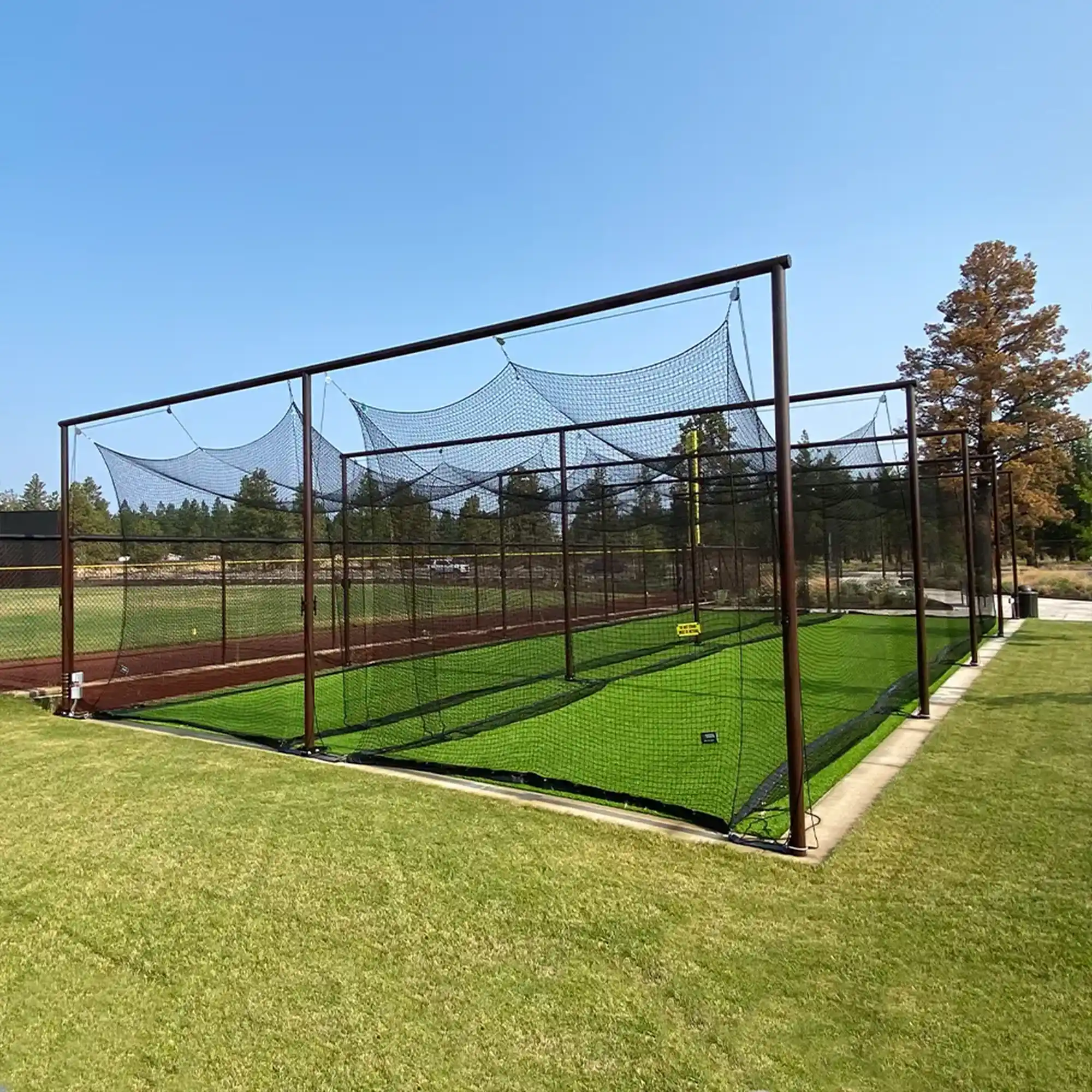
Overhead Batting Tunnels
- Available for baseball and softball
- Ground sleeve or base plate mounts
- #36 black nylon netting
- Single, Double, or Triple tunnel configurations
- Standard black powder coat finish
- Custom sizes and designs available upon request
- Foundation requirements vary based on local codes and soil conditions
Product Description
Training space is valuable, especially in indoor facilities where one area often serves multiple purposes. Overhead batting tunnels give you the flexibility to create dedicated batting and pitching lanes when you need them, then open the space for other activities when practice is over.
Sportsfield Specialties overhead batting tunnels are designed for indoor baseball and softball facilities, schools, colleges, universities, sports performance centers, recreation facilities, and training academies. Our overhead batting tunnels help maximize available floor space while providing a safe, organized environment for year-round player development.
Available in a variety of sizes and custom layouts, our retractable batting tunnel systems can be designed to fit your facility and training goals. The overhead design allows netting to be deployed for batting practice and stored overhead when the space is needed for other drills, practices, or events. This flexibility helps facilities make better use of every square foot without sacrificing training opportunities.
Overhead batting tunnels are part of Sportsfield Specialties’ complete line of baseball and softball training equipment. Pair them with our indoor batting tunnels, cantilever batting tunnels, baseball backstop netting systems, Ultra Cross® knotless netting, bat & helmet storage, pitching mounds, and other athletic facility products to create a complete training environment built for player development.
Whether you’re designing a new indoor training center or upgrading an existing facility, our team can help you choose the right overhead batting tunnels for your project. Contact Sportsfield Specialties to request a quote or learn more about our complete line of baseball and softball training solutions.
Product Documentation
Single Overhead Batting Tunnel
BTOBSPL - Single overhead baseball batting tunnel, base plate mount
BTOSSPL - Single overhead softball batting tunnel, base plate mount
BTOBS - Single overhead baseball batting tunnel, ground sleeve insert
BTOSS - Single overhead softball batting tunnel, ground sleeve insert
Double Overhead Batting Tunnel
BTOBDPL - Double overhead baseball batting tunnel, base plate mount
BTOSDPL - Double overhead softball batting tunnel, base plate mount
BTOBD - Double overhead baseball batting tunnel, ground sleeve insert
BTOSD - Double overhead softball batting tunnel, ground sleeve insert
Triple Overhead Batting Tunnel
BTOBTPL - Triple overhead baseball batting tunnel, base plate mount
BTOSTPL - Triple overhead softball batting tunnel, base plate mount
BTOBT - Triple overhead baseball batting tunnel, ground sleeve insert
BTOST - Triple overhead softball batting tunnel, ground sleeve insert
Frequently Asked Questions
What is an overhead batting tunnel and how is it different from other systems?
An overhead batting tunnel is a semi-permanent system supported by structural framing above the hitting area rather than relying on ground-level frames alone. Compared to other styles, it creates a more defined training lane while keeping the footprint clean and organized for outdoor or hybrid training spaces.
When is an overhead batting tunnel the right choice for a facility?
It’s a strong fit when you want a dedicated outdoor hitting area that stays consistent over time. Programs that run structured practices or multiple hitting stations often choose overhead systems because they create clearly defined lanes without needing a full enclosure building.
What configuration options are available for overhead batting tunnels?
Sportsfield offers single, double, and triple tunnel configurations. This allows you to scale the system based on roster size, practice flow, and available space without redesigning the entire setup later.
How do I decide between ground sleeve and base plate mounting?
It depends on your installation conditions. Ground sleeves are typically used when installing into new concrete footings, while base plates are often preferred for existing slabs or when you want a simpler install approach. Both options are designed to provide a stable, long-term structure.
What type of netting is used in overhead batting tunnels?
These systems typically use #36 nylon netting, which is well-suited for high school and collegiate level use. For higher-level or specialized applications, upgraded netting options can be considered depending on usage intensity.
Can these tunnels be installed on synthetic turf or natural grass?
Yes. Overhead batting tunnels are commonly installed on both surfaces. The key factor is how the foundation and mounting system are designed to work with the surface and underlying structure.
Are overhead batting tunnels suitable for multi-team or shared facilities?
Yes. Multi-lane configurations make them a practical solution for shared spaces. By creating separate hitting lanes, multiple athletes or teams can train at the same time without interference.